Annual Conference 2026
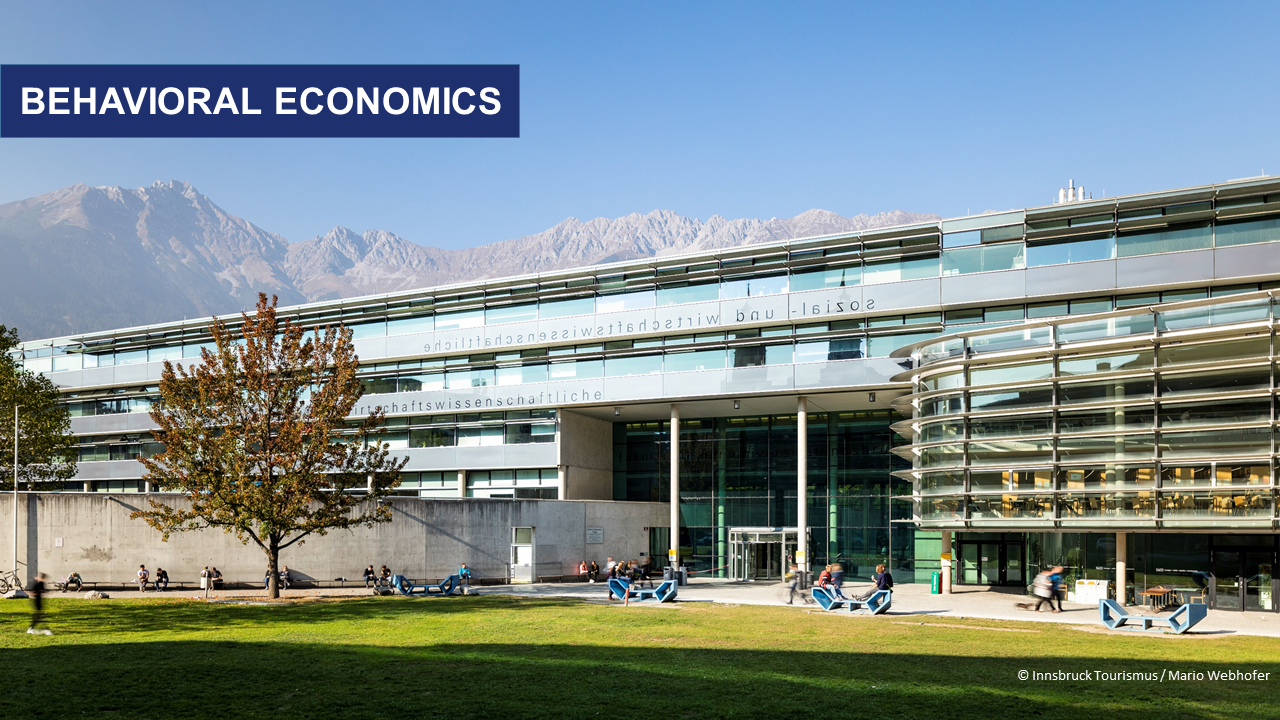
Universität Innsbruck
Campus Universitätsstraße
Universitätsstrasse 15
6020 Innsbruck
Austria
Organisers
Local Organisation: Markus Walzl (University of Innsbruck)
Core Conference: Urs Fischbacher (University of Konstanz)
Open Meeting: Conny Wunsch (University of Basel)
We would like to thank everyone involved and the Innsbruck team for the successful conference. We're sharing photos here on Flickr.
Registration is closed:
Prices:
VfS member...........................189.00 €
VfS member (reduced fee)......113.00 €
Externals...............................375.00 €
Students (Bachelor / Master)....40.00 €
Receptions are included in the price. You can find information on booking a hotel further down this page.
Cancellation conditions:
Cancellation by July 19, 2026: 20.00 € handling fee
Cancellation July 20 - August 22, 2026: 50% refund
Cancellation August 23 - September 16, 2026: no refund
Open Meeting - Call for Papers
In addition to the core conference, the open conference section forms an integral part of the VfS Annual Conference. Contributions to the Open Meeting could be submitted from February 1 to March 1, 2026, covering all areas of economics. Submissions could be made either as individual papers or as organised sessions. Please find the full programm inklusive sessions of the Open Meeting under the link 'Conference Programme'.
Core Conference: Behavioral Economics
Behavioral Economics has developed into an independent field of study over the past few decades and is now also found within individual subfields of economics, such as Behavioral Finance, Behavioral Macroeconomics, or Behavioral Industrial Organization. What all these approaches have in common is that they are based on a richer understanding of human behavior, going beyond the standard assumption of rationality and self-interest.
Well-known economists from the early days, such as Adam Smith, had already questioned the standard assumptions. However, at that time, there was no convincing alternative model, and in most cases, the standard assumptions provided good predictions and served as the basis for economic policy recommendations. The experimentally discovered "biases"—systematic deviations from the standard assumptions—were the first steps toward behavioral economics, initially undertaken by psychologists. Over time, it became clear that these observed biases were sufficiently systematic to build independent theories of behavior and to offer recommendations on an individual, economic, and political level. These recommendations were increasingly tested in field experiments. In particular, 'behavioral nudging'—influencing behavior without explicitly restricting it—was tested extensively, but has also sparked significant controversy.
Current research questions concern the heterogeneity of preferences and biases—how they differ across cultures and how they have developed over time. And how do they matter? What environments and institutions are most affected by biases, where have these biases a strong impact on welfare? And, of course, which interventions can leverage specific biases to produce positive effects, and what measures can reduce biases where they have negative consequences?
Our keynote lectures provide us spotlight on such topics. Ernst Fehr (University of Zurich) has made seminal contributions to our understanding of social preferences, fairness, reciprocity, and cooperation, helping to broaden the traditional concept of homo economicus. Matthew Rabin (Harvard University) has made fundamental contributions to modeling human behavior, such as reciprocity, risk, or reference points. Ulrike Malmendier (University of California, Berkeley) conducted influential studies on cognitive biases such as time inconsistency or overconfidence in laboratory and field experiments, and most recently on how past experiences shape economic preferences and beliefs.
The core conference addresses the question of how Behavioral Economics is changing the concept of human nature in economics and how this change is reflected in economics, politics, and society. This question will also be explored in a panel discussion. Ulrike Malmendier and Lucia A. Reisch will their perspectives on this topic. They are joined by Martin Kocher (OeNB, University of Vienna), known for his experimental work on cooperation and trust, who also serves as Governor of the Oesterreichische Nationalbank. Ernst Fehr (University of Zurich) will be able to share with us how a leading researcher brings insights from research into policy advisory work.
Your Stay in Innsbruck
Innsbruck Tourism provides us with a portal for booking your hotel room. For individual enquiries regarding hotel bookings, please contact
Innsbruck Convention Bureau
meeting@innsbruck.info
+43 512 53 56 9704
The best way to use public transport is with the Welcome Card, a free visitor card for the Innsbruck region, which is available to guests staying for two nights or more at participating hotels. With this card, guests can use public transport in the region free of charge and also benefit from various discounts on leisure activities.